
Creating Project Youth, part one: What’s in a name?
Author: Joel Winston, Head of Communications
A name can make a big difference to whether someone chooses to find out more about a research study. The right name can help make the study feel relevant and welcoming, while the wrong name might leave people uncertain about what it is and whether it is meant for them.
When we began developing a new identity for the Adolescent Health Study, we needed a name that would help us recruit and engage young people across a wide age range and from different backgrounds. It also needed to be clear and reassuring for parents and carers, whose understanding and support will be important to the study’s success.
Starting with our audiences
We began by exploring a long list of possible names and straplines.
To start with, we ran seven focus groups including young people (aged from eight to 22 years), and parents of primary and secondary school pupils. The 41 people who took part came from different parts of the UK and had a mix of ethnic and socioeconomic backgrounds.
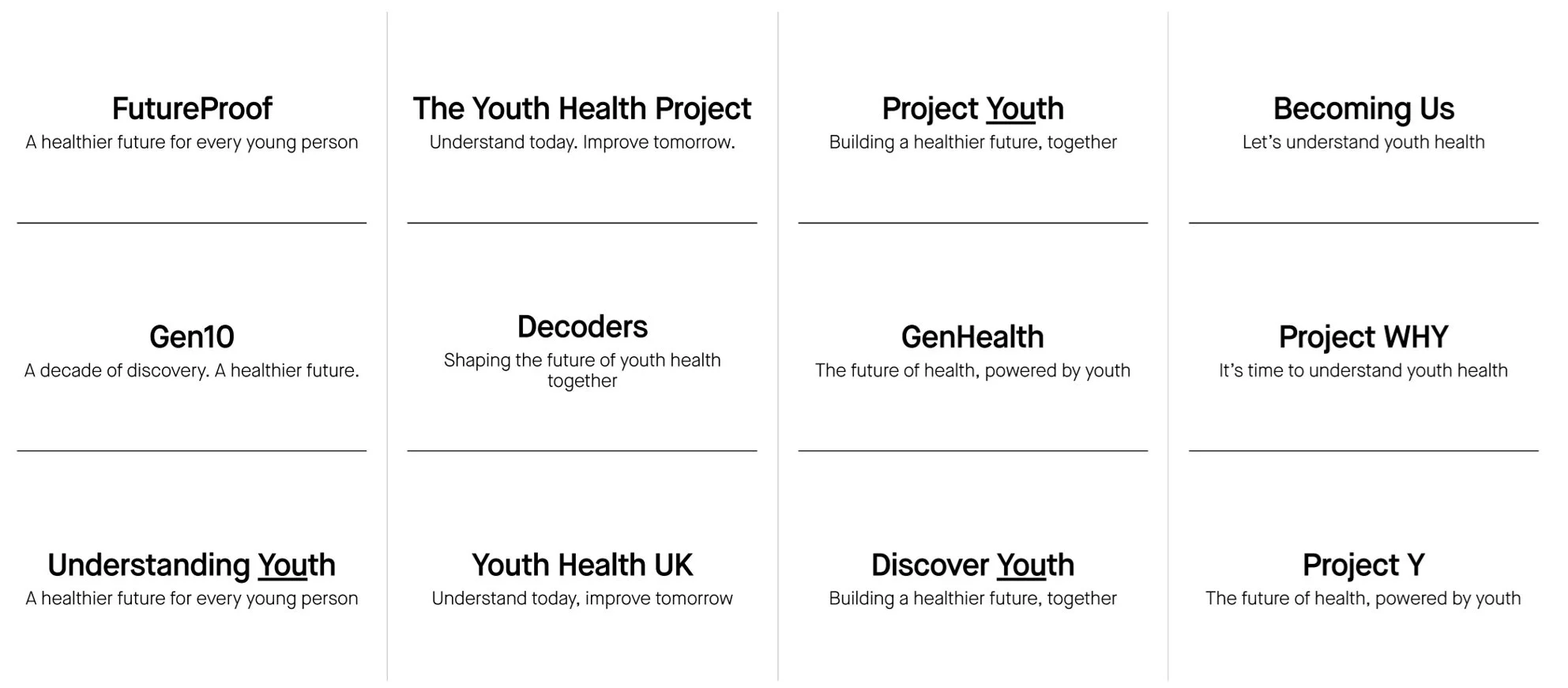
The 12 shortlisted names
We asked people to consider 12 possible names and straplines. They also had the chance to suggest new names and language of their own.
Young people liked language that spoke directly to them and gave them a sense of agency. They told us that they liked names that included “you”. It helped them feel like partners in the research, rather than just research subjects.
The people in the focus groups also told us not to be too clever with the name. They wanted clear and authentic language that helped explain what the study was about. Words that connected to health were important, but names that were too abstract could be confusing.
The study will be running over many years, so we also needed an identity that would last. A name that felt very current or trendy today could quickly become dated, particularly across such a wide age range.
Testing the shortlist nationally
We used the focus group findings to come up with a shortlist of names and straplines which we then tested in an online survey.
More than 2,000 young people and 1,200 parents took part. We made sure there was a good mix of ages (8-25 years), and people from different socioeconomic groups and ethnicities. This was to help us understand whether the options worked for a broad range of audiences.
Project Youth emerged as the strongest combination overall. It was the highest scoring name choice for young people, with 21% saying it was their favourite, and second highest for parents (22%).
We also looked at how often each name appeared in people’s top three favourites. Participants may not have selected a name as their favourite, but if it was in their top three, that indicates that it’s still a good choice.
Project Youth achieved the highest result out of all name options with both audiences, chosen as one of the top three by 58% of young people and 61% of parents.
Importantly, these results were consistent across all the different groups included in the testing. There was no significant variation by age, gender, ethnicity or socioeconomic group.
As well as understanding what people like, it’s just as important to know what they don’t like. Some brands might want to be different to spark conversation and generate interest. That approach might work well for some organisations, but we don’t want to alienate people in this study. We want to appeal to as wide a group of people as possible.
Encouragingly, Project Youth had the lowest rejection rate of the options tested. Less than 10% of young people and parents disliked it, making it a safe choice. Although going for a safe choice may not seem particularly exciting, it helps ensure that we’re being as inclusive as possible.
Other things we learnt about ‘Project Youth’
Not every participant interpreted the word “project” in the same way. Some associated it with something exciting, futuristic or like a secret mission. Others thought of homework or raised concerns about young people being treated as test subjects.
This feedback reminded us how important it can be to pair the name with clear supporting language. Testing showed that adding a strapline helped explain what we’re trying to do and addressed some of the concerns associated with the name alone. The highest rated strapline was “Building a healthier future, together”.
Choosing our new name and strapline was not a matter of selecting the one that we liked best. It was an evidence-led decision informed by people across the age range we hope to engage, as well as the parents and carers whose confidence will be essential.
The result is a name shaped by the audiences it needs to reach and grounded in evidence about what works for them.
Coming soon: ‘From feedback to final design’